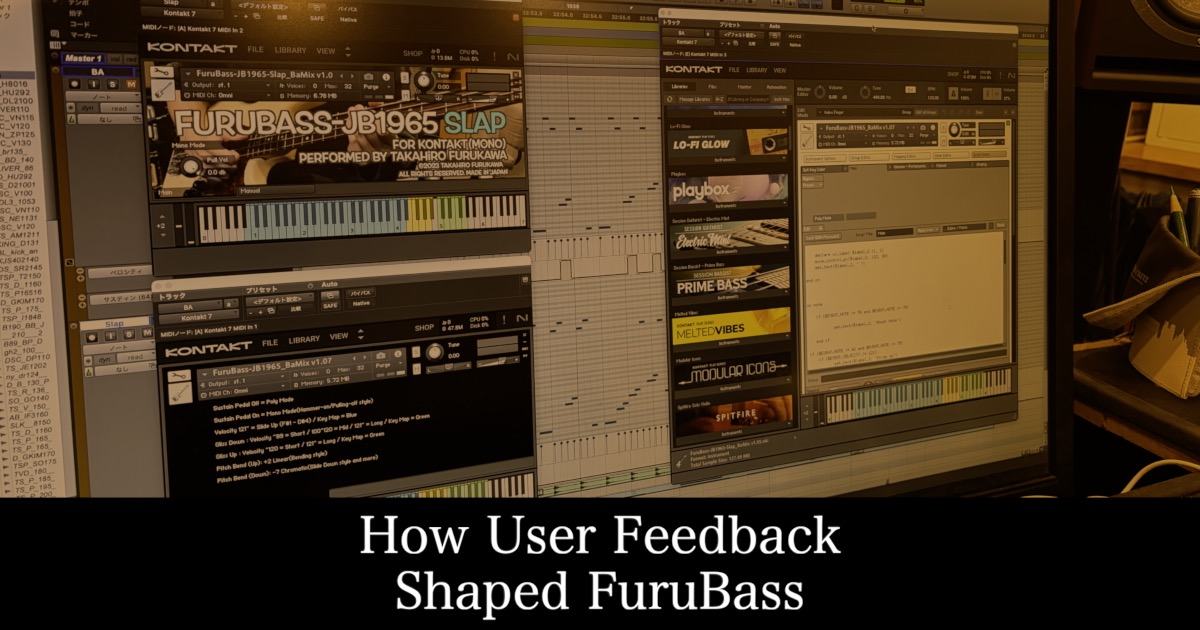
When I first released FuruBass-JB1965, it was simpler than the version you see today.
At the time, I intentionally left out certain techniques such as hammer-ons and pull-offs.
Part of the reason was technical — adding those articulations would dramatically increase the number of samples.
But more importantly, I was deeply focused on one principle:
Keeping FuruBass lightweight and fast.
As a bassist, I felt many subtle details became difficult to notice once placed inside a full mix — so I prioritized what mattered most in real music production.
After the release, FuruBass started reaching more musicians — and with that came feedback.
Some users wanted more realistic left-hand phrasing:
“I’d love to have hammer-ons and pull-offs.”
Others asked for more flexibility:
“I like that stronger velocity triggers slap pull, but I wish I could adjust the pull volume.”
And some requests came from real production needs:
“I want access to a 5-string range.”
“I wish I could slide down from sustained notes.”
To be honest, implementing these ideas while preserving the original philosophy of lightweight performance and easy programming was not always easy.
But over time, I worked through those challenges one by one.
And in the end, user feedback expanded what FuruBass could become.
Looking back, I think being a bassist may have made me too willing to say:
“That detail probably isn’t necessary.”
But the reality is:
Most bass libraries are not used by bass players.
They are used by producers, composers, and musicians with very different workflows.
That realization slowly changed my perspective.
FuruBass started as:
“A bass instrument that sounds like my bass.”
But over time, the goal evolved into something bigger:
“A bass instrument that feels easy and musical for anyone to use.”
User feedback also changed how I think about usability.
Personally, I rarely read manuals when buying software instruments.
I prefer learning by using.
Then one day, a user asked me something that was already explained in the manual:
“Can I change the length of the gliss down?”
That moment changed how I thought about usability.
Maybe most people don’t want to read manuals either.
That idea eventually led to features like Articulation Labels and the Manual Tab, designed to make FuruBass easier to understand without needing to constantly look things up.
And that process continues.
FuruBass has gradually evolved since its original release — but I still don’t think it’s finished.
I continue listening to user feedback while also questioning my own assumptions:
How can this feel even more musical, intuitive, and inspiring?