
“Vintage means old-sounding.” It doesn’t.
The bass recorded for FuruBass-JB1965 was built in 1965, but its specification is barely different from a passive Jazz Bass built today. Two pickups, two volume controls, one tone control. An instrument built six decades ago, still running on a design that never needed replacing.
So why this particular bass?
The Instrument
I spent years looking for this one. The electronics and the hardware are as they left the factory, with no later parts swapped in. I’ve owned it for about ten years.
It never goes on stage. It’s a recording instrument and always has been. On most of the records I’ve worked on, the bass you’re hearing is this one. No other bass I own comes close to it in the amount of trust I put in it.
The frets, though, are not original. It had already been refretted before it reached me, and I’ve had it refretted once more in the ten years since.
That’s part of why I trust it.
Frets wear down. They always do — that’s what playing does to them. So an instrument that still has its original frets is, read another way, an instrument that hasn’t been played much. It’s a collection piece that spent its life in a case. This one is the opposite. Frets that have been replaced more than once are evidence of sixty years of continuous playing.
And an instrument that has been played sounds better than one that hasn’t. The difference is not subtle.
One more thing mattered when it came to sampling: the fingerboard.
This bass comes from the point where the fingerboard construction changed from a slab board to a thin veneer — a cost-saving decision at the time. The side effect was a stronger neck. Sixty years on, with regular maintenance, it’s still in genuinely usable condition.
A stable neck and well-maintained frets turned out to be decisive. Together they mean the tone doesn’t shift much from position to position, and the pitch doesn’t drift. When you sample an instrument across its entire range, any unevenness like that ends up baked into the library. FuruBass-JB1965 is consistent from the low positions to the high ones because the instrument itself is.
It isn’t good because it’s old. It could be sampled because it’s been played for sixty years and still sounds like this.
How It Was Recorded
I’m a bassist, but I’m also a composer, arranger and sound producer. So it isn’t enough for an amp to sound good in the room. What matters is how it sounds once it’s been recorded, and I’ve spent a long time on that question.
FuruBass-JB1965 was captured through two paths: a DI and a miked amp.
The DI
Umbrella Company SIGNALFORM ORGANIZER
A DI that adds no color and passes the instrument through exactly as it is.
I have one rule for the line signal: keep it completely pure, straight from the instrument. No compression. Nothing shaped on the way in — once you commit to a sound at that stage, you can’t take it back. I wanted the DI to do nothing at all.
The Amp
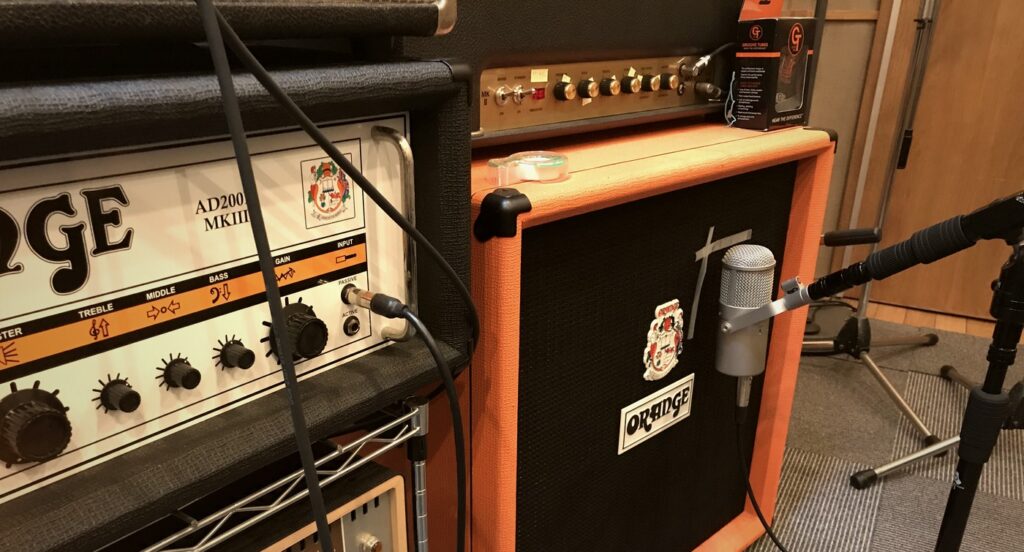
Something I noticed while searching for a bass amp: an all-tube design — tubes in both the preamp and the power section — carries a sense of pressure that its wattage doesn’t account for. And that pressure is exactly what turns into presence once there’s a microphone in front of it.
I kept looking with all-tube as a hard requirement, and the amp I settled on, the one used for this recording, is an Orange.
For cabinets I tried everything from a compact 1×12 up to a full 8×10. What I settled on sits between them: a 4×10. It’s the point where the volume of the box and the ability to genuinely drive the speakers balance out.
The microphone is a Neumann U47 FET. Nothing else puts that much weight into the low mids of a bass. Placement is straightforward — close, just off the center of the cone.
The preamp is an Aurora Audio GTQ2. It catches the mic signal with a thick, clearly drawn outline, as though someone had gone over it with a marker.
The compressor is a WesAudio β76, and compression is applied only on this amp path. It has the responsiveness of the 1176 family, with a sidechain filter that lets the low end pass through untouched. For compressing bass, that was non-negotiable.
Why This Combination
The best bass sound, to me, is one that holds its place inside the arrangement.
You can make a bass cut through with treble. But that means reaching into the range where the guitars and the piano already live. A bass should cut through in its own register — the low mids. That’s how I think about it.
Every piece of gear above was chosen one at a time, out of practical work, to make that idea possible.
BaMix — How the Two Paths Meet
The sound you hear the moment you load FuruBass is BaMix: the DI and the amp blended into a single, ready-to-use tone.
In JB1965, the two paths have clearly separate jobs.
The DI provides the core and the definition. The amp adds the weight and the air.
That’s part of why the line signal is kept clean. If the path responsible for definition arrives already colored, adding the amp on top only muddies it. Let the core stand as a core, then layer the tube and the cabinet over it.
The balance between them is fixed at the proportion I’ve arrived at over years of working as a bassist and a producer. It isn’t a setting for you to dial in — it’s a decision that has already been made. That’s the point: you load it and you start writing.
You can still treat the DI and the amp as independent tones whenever you want to. BaMix isn’t a limitation. It’s a starting point.
I’ve written about the thinking behind BaMix itself in The 3 Principles Behind FuruBass.
The Decisions
I’ll be straightforward about this. Turning the instrument into a library meant giving some things up.
The first was pickup blending.
It’s one of the defining features of a Jazz Bass. Roll the volume down on the front pickup and you get the articulate, focused sound Jaco Pastorius is known for. Roll the volume down on the rear pickup instead and you get something fat, unruly and funky. Between those two points there’s an enormous range of character.
Reproducing that in a library would take an impossible amount of recording and programming. And that complexity runs directly against the idea FuruBass is built on: it should be usable the moment you open it.
So both pickups are fixed wide open — the most common setting, and the one people actually reach for.
The tone control is fixed wide open for the same reason. It’s a genuinely rewarding control on the real instrument, and I made the same call.
Which means FuruBass-JB1965 can’t give you that Jaco sound. I knew that going in. The choice wasn’t to include everything. It was to include the one setting that gets used most, in the best condition I could capture it.
What This Model Does That Others Don’t
Each of the four FuruBass models does something the others can’t. For JB1965 there are two answers.
1. It’s the reference point
When someone says “electric bass,” the sound most people picture is a Jazz Bass. Bass is rarely the lead voice in a song; it’s the part that holds the rest together. Sitting in a track and simply staying there, reliably — that’s what a Jazz Bass does better than anything else, and it’s why it has been chosen on so many records.
2. That reference came from an instrument that can’t be replaced
“A standard Jazz Bass sound” sounds like something you could get anywhere. But what FuruBass-JB1965 plays isn’t a Jazz Bass in the abstract. It’s one specific 1965 instrument, played continuously for sixty years, and there is no second copy of it.
Being standard and being ordinary are not the same thing. JB1965 stands where those two don’t overlap.
Where It Sits in a Track
When I’m deciding which bass a song needs, my starting point is always the same.
Jazz Bass first.
Not because it’s the best — because it’s the baseline.
Unless you’re confident that another model suits the song better, reaching for a Jazz Bass is the right call. That’s what being the standard of the instrument means.
I’ve used this bass on pop, rock, city pop, funk, and film and TV scoring. It has never been tied to any one of them.
And that matters most if you don’t yet have a clear picture of how the different bass models sound. Get your ear used to a standard Jazz Bass first, and the differences will be obvious the moment you hear a Precision Bass or any of the others. That’s also where the reason FuruBass has more than one model starts to make sense.
JB1965 is the entry point to FuruBass, and the reference the other three are heard against.